

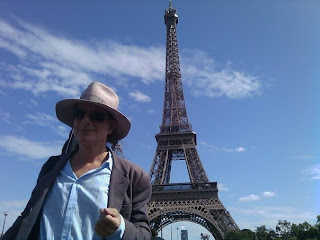
Human, citizen of the culture and the world, Gary Lucas isn’t a common artist (if you listen to some of his albums you’ll notice that). He can be considered the son of a great generation. He was nominated for a Grammy and was described as one of the best and most original guitarists in the United States (and he only took lessons for a month!). He leads a super-band called ‘Gods & Monsters’ (called a ‘21st century Cream’ by Rolling Stone magazine), that used to have the marvelous Jeff Buckley in the early 90’s. Nowadays it features Gary (vocals and guitar), Ernie Brooks (bass), Billy Ficca (drums), Jason Candler (alto sax) and Joe Hendel (trombone and keyboards). Ocasionally Jerry Harrison (keyboards) joins them live or in the studio. The name of the groups comes from the movie ‘The Bride of Frankenstein’, where Dr Praetorious says ‘To a New World of Gods & Monsters’.
He has played with a lot of artists: Nick Cave, Captain Beefheart, Iggy Pop, Elli Medeiros, Bruce Springsteen, David Johansen, Lou Reed, Najmha Akhtar, Patti Smith, John Cale, Sally Kwok, among others. He also has played with the talented Leonard Bernstein, who was an excellent pianist and a remarkable American conductor of the New York Philharmonic Orchestra.
He’s a globetrotter who takes a tape recorder wherever he goes to record every idea he has (he learnt this from his friend Captain Beefheart).His musical influences have ardently marked him and his shows are 50% improvisation.
He talks about his musical influences in this interview:
-Pocho: Would you agree with me if I say that you're a multi-skilled artist?
Gary: Absolutely. I try and do it all.
-Pocho: Your first contact with the music was through Duane Eddy's song 'Dance with the Guitar Man'. What artists do you feel have influenced you and your work?
Gary: So many: Syd Barrett, Bela Bartok, Richard Berry, Jeff Beck, Rolling Stones, The Smiths, The Doors, Incredible String Band, among others.
Gary’s taste for classic cinema is reflected even in the name of his band. This is a characteristic that identifies him: he has played in a lot of film festivals all around the world, playing compositions to accompany the film projection. He has done this with the 1920 film ‘The Golem’ and with the 1931 movie titled Spanish ‘Dracula’. Last year, he played in the Havana Film Festival, where he’ll be playing again the 10th of December presenting a Brazilian film called ‘Esta Noite Encarnarei no Teu Cadáver’.
-Pocho: You're very related to the classic cinema. How did you discover it?
Gary: I just got a taste for it at screenings at Syracuse University and also occasionally on television and fell in love with this enchanted world of dancing shadows.
Lucas has played in a lot of places around the world, including Russia, Spain, Brazil, Mexico, Colombia, Italy, France, Belgium, Holland, United Kingdom, Cuba, China, among others (unfortunately for us, he hasn’t played in Argentina yet). He has a very strong commitment with the global culture.
-Pocho: You've played in so many places around the world, Are you optimist about the future of the humanity?
Gary: Not sure, I try and ignore all the pessimistic and gloomy developments (today I just read a report that the polar ice caps were indeed melting (bad news for Patagonia, and the rest of the world)) and just continue on my way trying to entertain and astonish people. I think that's the best thing one can do as an artist to help cheer up the populace as we race towards extinction.

On his album ‘the Edge of Heaven’ he plays mid-century Chinese pop songs. As an artist, he picks up the native culture of every country he visits and that’s another characteristic that we have to take into account to understand and identify him.
-Pocho: The Chinese culture seemed to have caused you a great impression (because of your album called 'The Edge of Heaven'). What things do we have to learn about that culture?
Gary: I am no sociological expert, I just love that music. I hesitate to make any sorts of pronouncements about Chinese culture except that I find it profoundly elegant and moving, but I feel the same way about Latin culture!
-Pocho: Considering that the American culture has dominated the world since the mass media and the globalization period, and also considering that you're a musician that picks up the native culture of every country you visit...Do you see this influence as a negative influence or as a positive influence?
Gary: I think the contributions that America has made in music historically (particularly in the fields of jazz, blues and rock) remain significant, world-shaking, and worthy of veneration, but the prevailing trends in the current American culture vis-a-vis films and television I cast a rather more jaundiced eye upon...I think these trends have contributed to the dumbing down of the world by their very prevalence and mass influence by and large, and I weep for that , I am ashamed about a lot of it quite frankly.
Behind every artist is hidden a normal person, and Gary put us on the surface to understand more about his life, and finishes the interview with a personal wish that he always keeps with him: he wants to play in Argentina.
-Pocho: After all these years that you've been sharing a lot of experiences in every part of the world (and also visiting Cuba)...Do you feel a privileged man?
Gary: Yes, but saying that, I can assure you it's not easy being me...and what may seem on the surface a very free-wheeling and easy and privileged lifestyle is actually filled with all the concomitant problems and challenges on a macro level of a survival nature just like any other non-mainstream artist . I am only happy when I am working, and I don’t feel I work enough to tell you the truth despite my efforts to fill up the calendar with gigs. I am not complaining mind you...but for instance, I still haven’t performed in Argentina despite repeated efforts!


 El tema de apertura es "Amigos" (Friends) un pegadizo tema con un aire que excede lo estrictamente blusero, es más, se me ocurre decir que llega hasta lo country o folk, lo cual justamente lo hace tan pegadizo. El juego entre King y los coros es además gran parte de la vida del tema. "Tengo tus tristezas" (I Got Them Blues) hace imaginar al guitarrista cantando, bien al estilo bohemio, en la calle cantándole no se a quien, con ciertos tonos de opacidad y alegría mezclados entre sí creando un equilibrio perfecto, logrando la atmosfera marca registrada de B.B. King. "Nena, soy tuyo" (Baby I'm Yours) reflotado por los Arctic Monkeys últimamente es la tercer canción y quizás, si no sos estrictamente del blues, es el tema que más te va a gustar, por lo tenaz de "el rey" para aferrarse al tema e interpretarlo y cantarlo con pasión. El lado A cierra con "Levantado a las 5 am" (Up at 5 am), el tema más opaco de todos (en el buen sentido, referido a los graves) que llega a las raíces del género, con una guitarra que acompaña perfectamente lo que se quiere decir en el tema, el equilibrio blusero del disco.
 Pensándolo a la distancia, este disco, del año 1975, marca el quizás decir "acá estamos" por parte de este género, en el contexto de un mundo "convulsionado" y en "transición" por el auge del rock y el nacimiento de nuevas tendencias y corrientes no mucho tiempo después (música de los 80's, auge de la música disco).
 5 años después, luego de muchas especulaciones, Page, Plant y Jones vuelven a reunirse juntos en un escenario para tocar en el famoso Live Aid (exactamente el 13 de Julio) en el estadio JFK de Philadelphia. Fue una actuación, lamentablemente, para el olvido por tres razones principales:
 Naturalmente la historia siguió y luego de algún que otro intento de vuelta un año después (vuelta que quedó trunca por un accidente automovilístico sufrido por Tony Thompson, quien iba a ser el baterista), Zeppelin vuelve al ruedo para tocar el 14 de mayo del 88' en el 40 aniversario del sello Atlantic, en el Madison Square Garden. En esta oportunidad el que toma los palillos es Jason Bonham (hijo del fallecido John), quien había aprendido de su padre las canciones de Zeppelin y que, según declaraciones de Plant a la revista Rolling Stone, pensó en su momento que tocar las canciones del grupo era algo "hereditario". En aquella oportunidad tocaron Kashmir, Heartbreaker, Whole Lotta Love, Misty Mountain Hop y Stairway to Heaven. Nuevamente "fallan" (a mi juicio con una performance superior a la del 85'). Las razones luego exhibidas fueron:
 En el 95' se produce un acontecimiento esperado: la introducción de Led Zeppelin al salón de la fama del rock en el Waldorf Astoria Hotel. Los encargados de introducir a esta mítica banda son Steven Tyler y Joe Perry de Aerosmith. En los discursos los tres agradecieron con Zöe y Jason Bonham agradeciendo en representación de su padre. El que produjo las mayores risas fue John Paul Jones. El bajista, con su perfil bajo característico, lanzó frente al micrófono: "Gracias a mis ex compañeros por acordarse de mi numero de teléfono", provocando la carcajada del público y las risas, quizás por compromiso, de Page y Plant. Luego de la ceremonia la banda toca junto a los dos Aerosmith (y junto a Jason obviamente) 3 temas: Bring it On home, Long Distance Call Blues, Baby Please Don't Go y junto a Neil Young y Michael Lee (quien toma el lugar de Jason Bonham) tocan la canción: When the Leeve Breaks. Esta presentación reflotó un poco la magia que se quería volver a ver, tocando en un gran nivel. Long Distance Call Blues y Baby Please Don't Go fueron los temas que en lo personal me gustaron mas, con una combinación entre Tyler y Plant fantástica.
 “No quería solamente una banda, sino una usina: cuatro virtuosos que crearan el quinto elemento” le dijo Page a la revista Rolling Stone. De aquellos deseos de tomarse unas vacaciones de un par de años al formar esta banda de John Paul Jones, a la epopeya de convertirse indiscutiblemente en una de las mejores bandas de rock de todos los tiempos. En palabras de John Paul Jones, zeppelín fue una banda áspera. Un zeppelín de plomo áspero que pronto levantó vuelo: aún bajo el nombre de the New Yardbirds en 1968 deciden embarcarse en una gira por la península escandinava (por Suecia y Dinamarca): su primer concierto fue en Gladsaxe (Dinamarca), el 7 de Septiembre (solamente con 15 horas de práctica) donde tocan temas luego incluidos en su primer álbum (como “You Shook Me”, “Communication Brakdown” y “Babe I’m Gonna Leave You”, entre otros).
 Para promocionar su próximo álbum se realiza el tour europeo de Otoño, un tour muy corto que empezó el 3 de Octubre del 69’ y terminó el 12 de ese mismo mes. Finalmente el 22 de Octubre del 69’ sale a la luz Led Zeppelin II, el cual incluía canciones como “Heartbreaker”, “Ramble On”, “Moby Dick”, “Thank You”, “Whole Lotta Love”, entre otras. El álbum vendió más de 500.000 copias en su primer año, lo cual denota el interés de la gente por el mismo, y donde se ganan el mote de virtuosos. La publicidad giró en torno al slogan: “El Zeppelin II está volando”. Las sesiones de grabación se hicieron en Inglaterra y EE.UU. Emprenden el tour de invierno por EE.UU. unos días antes del lanzamiento del álbum, más precisamente el 17 de Octubre hasta el 8 de Noviembre de ese mismo mes. En palabras de Peter Grant (manager de la banda) en ese tour se dieron cuenta que podían ser aún más grandes que los Beatles y los Stones, con todo lo que eso significaba para la época.
 Ese año giran en Europa, EE.UU. y por primera vez por Japón, donde dan 5 shows (2 en Tokyo, 1 en Hiroshima y 2 en Osaka). Led Zeppelin IV sale a la calle el 8 de Noviembre del 71’ ante un cálido recibimiento por parte de la gente y la prensa. Actualmente es el álbum más vendido de la banda con 37 millones de copias (en Argentina es disco platino). El album incluía temas históricos como “Black Dog”, “Rock and Roll”, “Stairway to Heaven” (quizás el tema más famoso de la agrupación por su profundidad y sus cambios de ritmo) y “When the Leeve Breaks”. Los cuatro símbolos de la portada del disco se convierten en símbolo de cada miembro de la banda. Cierran el año con un tour por el Reino Unido.
 En el 76’ sale a la luz Presence , con el demoledor Achilles Last Stand como tema de apertura del álbum. Vuelven de un largo descanso entre abril y mayo del 77’ (estaba planeado para empezar antes pero se tuvo que posponer por una laringitis de Plant) luego del accidente auomovilistico sufrido por Plant en Grecia en el 75. Dan 44 shows de 51 acordados, lo cual se explica en la trágica muerte del hijo de Robert Plant por una infección estomacal.
